AKRAM
KHAN EVOKES THE POWER OF RITUAL IN
“THIKRA: NIGHT OF REMEMBERING”
The choreographer sets a mountain on fire as he pursues enlightenment.
July 2, 3 and 5, 2026
Alice Tully Hall, 1941 Broadway (at West 65th Street)
Presented by Lincoln Center’s Summer for the City
in collaboration with The Jacob’s Pillow Dance Festival
The Lincoln Center Contemporary Dance Festival
Pasculano Collaborative for Contemporary Dance
Thurs. and Fri. at 7:30 p.m.; Sun. at 2 p.m.
Visit https://www.lincolncenter.org/venue/alice-tully-hall, or call
the Box Office at (212) 258-9800
Reviewed by Robert Johnson July 2, 2026
Human beings naturally seek enlightenment, yet our shallow, modern
way of life cannot satisfy our yearnings. Chasing clickbait on our
phones and dollars in the marketplace, we become distracted and allow
our spiritual faculties to atrophy. In “Thikra: Night of Remembering,”
which the Akram Khan Company performed on July 2, in Alice Tully Hall,
the British choreographer offers an escape into a more vital world.
Returning to the ritual origins of theater, this piece presented by
the Lincoln Center Contemporary Dance Festival in collaboration with
Jacob’s Pillow features a cast of gutsy women who immerse themselves
in a spiritual search for identity. Their trials can be harrowing.
Though the setting is spectacular, and the dance filled with dramatic
movement, Khan doesn’t make it easy for us. As in our daily
lives, here, too, we must struggle to discern meaning. Set designer
Manal AlDowayan places the action before a rocky outcropping presumably
far from human habitation. A grotto reaches into the earth’s
mysterious depths, while a staircase rises to a platform where a Matriarch
(Mythili Prakash) in a mask and vestments towers above a suppliant.
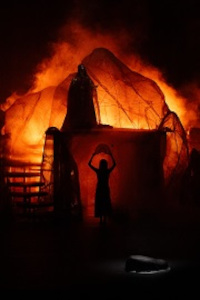 |
| Mythili Prakash and Elpida Skourou in “Thikra:
Night of Remembering,” Photo by Christopher Duggan. |
During the ritual, the dancers acquire the power to move seemingly
massive rocks. Though these naturalistic set pieces are less imaginative
than the menhirs and totems that Isamu Noguchi designed for Martha
Graham’s “Dark Meadow” (a more sophisticated ritual
dance performed earlier this year), AlDowayan’s mountain scenery
is transfigured by a mystic fire that glows within and emits fumes.
In addition to the Matriarch, the principals include characters known
as the Vessel and the Shaman. Yet another woman plays an ancestor
spirit, who must be revived, coaxed, and even coerced into participating.
These figures may also represent various stages of initiation.
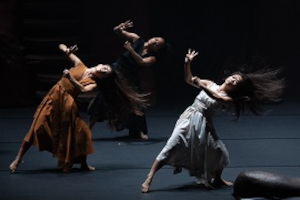 |
| Elpida Skourou, Joy Alpuerto Ritter and Ching-Ying
Chien in “Thikra: Night of Remembering,” Photo by
Christopher Duggan. |
The main action centers around Ching-Ying Chien, the ancestor spirit
dressed in white, who is dragged unconscious from the grotto and subjected
to a hair-pulling ordeal. She and the Matriarch embrace; and Chien
seems to write on Prakash’s body with her fist. Then, demonstrating
the power of mind over matter, the Matriarch upends a heavy stone
revealing an occult text inscribed on the bottom. Strangely, the ancestor
spirit is less evolved, and cannot budge the stone.
Meanwhile, a corps of six women have emerged from the wings. Seizing
their long hair, they twist it or extend their fists and pulse. Initially
they move in place, so that when they begin to travel---hopping, prancing,
and whipping the air---this newfound impulse has a powerful effect.
Khan contrasts violent movements with more subtle ones: sudden, sharp
adjustments of the women’s heads and hands, and darting eye-movements.
The dancers invest the choreography with great strength and pliancy,
as a sign of their devotion. The hair-tossing may be overdone, however.
The belief that hair enhances a person’s psychic abilities was
satirized last year in the Sci-fi film “Bugonia,” with
its council of elaborately coiffed extra-terrestrials.
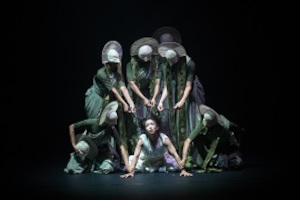 |
| Ching-Ying Chien and Akram Khan Company in Thikra:
Night of Remembering,” Photo by Christopher Duggan. |
At a certain point, Chien retires and Elpida Skourou
becomes the focus of the Shaman’s attentions. Skourou falls
into a trance, reclining on a rocky couch that the corps have dragged
with brute strength from the wings. Joy Alpuerto Ritter, wonderfully
fluent as the black-clad Shaman, presses on Skourou’s chest
and pulls her up. Employing her hands like psychic defibrillator paddles,
the Shaman revives Skourou, who goes on to perform a writhing, thrashing
solo.
PHOTO rj26071d.jpeg Elpida Skourou and Akram Khan Company in “Thikra:
Night of Remembering,” Photo by Christopher Duggan.
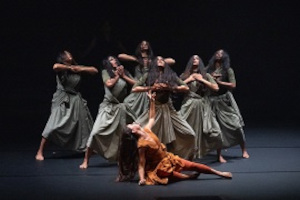 |
| Elpida Skourou and Akram Khan Company in “Thikra:
Night of Remembering,” Photo by Christopher Duggan. |
“Thikra” does not build to a single, climactic
moment like the Dance of the Chosen One, in “The Rite of Spring,”
however. Instead, a series of obscure episodes bring us back full-circle
to the beginning, with a masked and robed figure astride the platform
and demanding homage from the worshippers below, who gradually begin
to spin. The accompanying soundscape by Aditya Prakash and Gareth
Fry supplies effects throughout, combining the voices of an Anglo-Bulgarian
choir with birdsong and ominous rumblings.
Khan’s message in “Thikra” is well-taken. We should
all put down our phones, and attempt to rediscover our innate potential
as human beings. There are no short-cuts to enlightenment, however,
and whether the vicarious experience of ritual theater is enough to
jolt us from our habits of forgetfulness is a question viewers must
answer for themselves.
|